selected item
Article
2 min read
• March 4, 2026Eight years, one goal: Reuse more water at Kearl
- Imperial’s Enhanced Thickened Tailings (eTT) technology received up to $12.8 million from Emissions Reduction Alberta to advance toward commercialization.
- The eTT process speeds water recovery and improves tailings drainage and supports better water reuse and long‑term reclamation at Kearl.
- Developed by a cross‑disciplinary team starting in 2017, the technology proved successful in lab and pilot trials with larger‑scale testing planned ahead of a potential 2027 deployment.
Article
2 min read
• March 4, 2026A new Imperial-developed technology is helping reuse more water at Kearl — and it just got a major boost.
Emissions Reduction Alberta (ERA) has awarded up to $12.8 million to help advance our Enhanced Thickened Tailings (eTT) technology, supporting the next step toward commercialization.
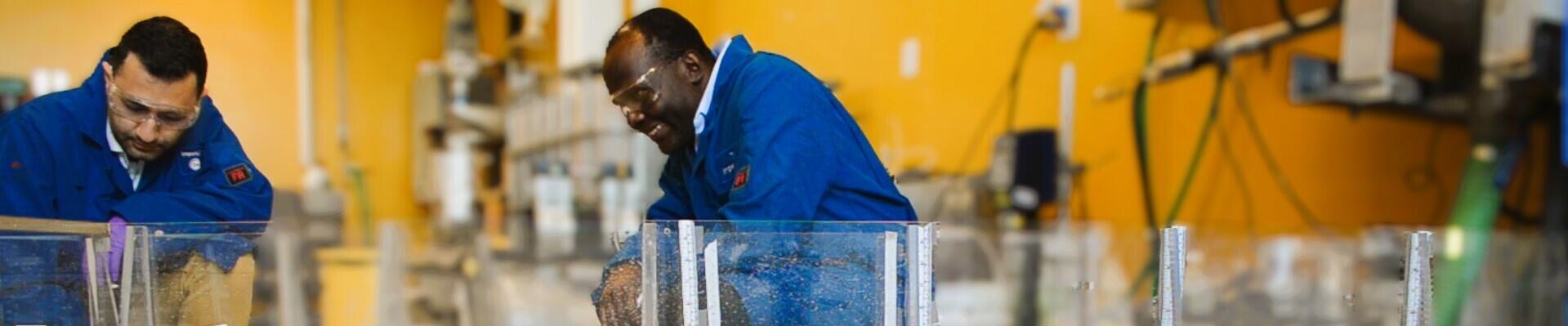
Tailings, a byproduct of bitumen production, are mostly water mixed with sand and fine clay that settle slowly and make water recovery challenging. Imperial’s eTT process speeds up the water recovery process by separating water faster so it can be reused sooner, while producing tailings that drain better and can be stacked more safely.
“Our early trials showed that eTT dewaters better, getting the material to squish, stick and stack better,” explains Scott Cebula, mining research manager. “That’s a big step forward for water reuse and long-term reclamation.”
The idea behind eTT dates back to 2017, when the Kearl team faced a real risk: without better tailings treatment, water shortages could limit production. A small, cross-disciplinary team moved fast, reviving and adapting a shelved research concept and testing it directly in the field.
And it worked.
“We were scrappy,” Scott says. “We needed something that worked in the field, or we needed to fail fast and move on.”
By rethinking the chemistry of the thickened tailings, they created eTT: tailings that drain faster, stick better and support future reclamation.
Lab and pilot results in early 2025 confirmed the breakthrough. Next up: larger-scale testing and readiness work toward a potential 2027 deployment.
“This success belongs to the team,” Scott says. ““It comes from close collaboration among our planning, operations and research groups. That partnership continues today and shows how quickly new technology can be developed, tested and put into the field.”
Learn more about the ERA’s Tailings Technology Challenge.
Stories

Celebrating 100 years of Esso – together
2 min read
• Oct. 5, 2026
Norman Wells and Sahtú communities commemorate 106 years together
2 min read
• Oct. 5, 2026
Momentum building for potential growth
3 min read
• Sept. 25, 2026
All in for students, STEM and building strong communities
Community
3 min read
• Sept. 25, 2026
Actually, curiosity never takes the summer off
Community
3 min read
• Sept. 10, 2026
The end of an era at Norman Wells
2 min read
• Sept. 1, 2026